

Agent AI
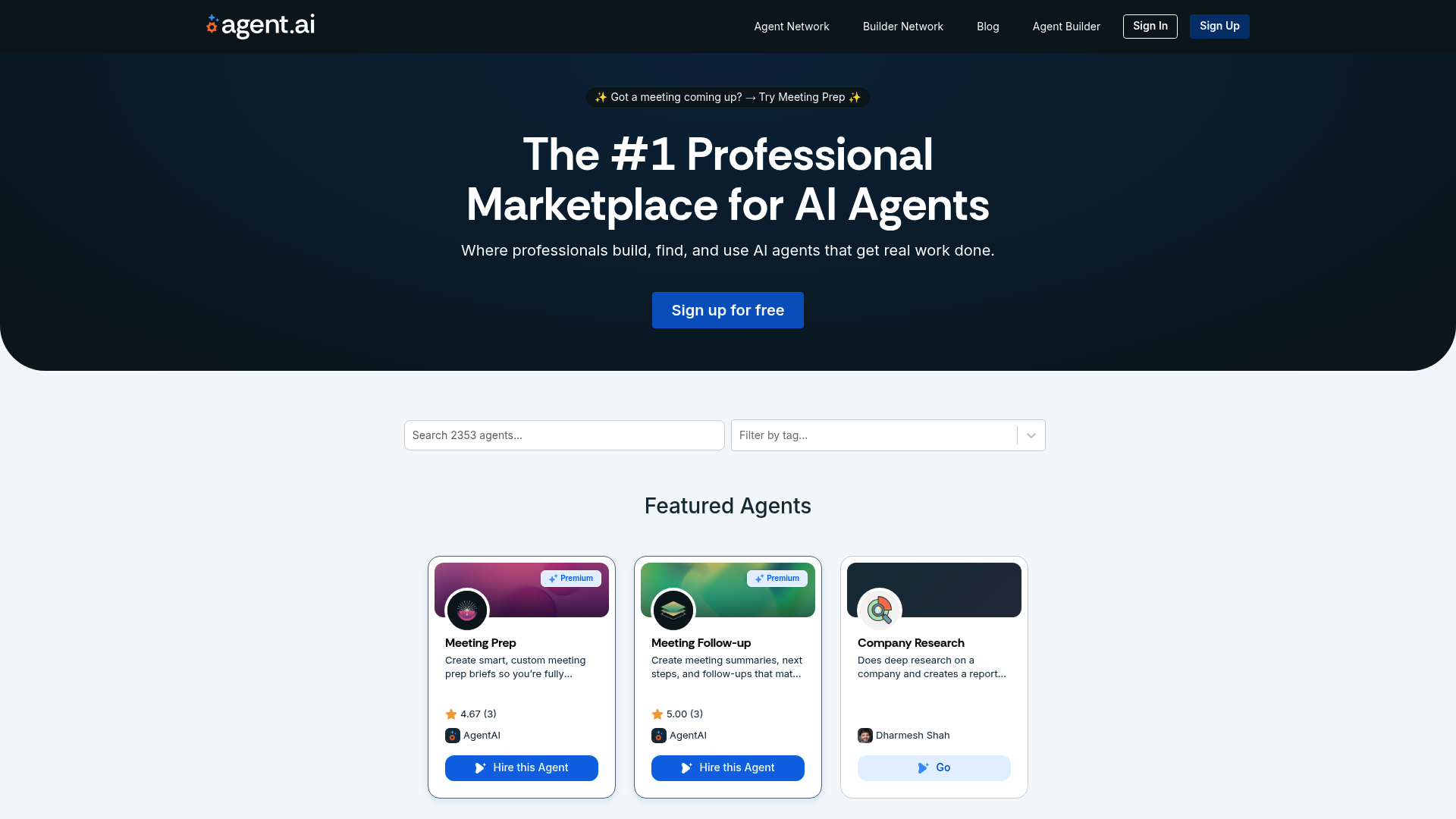
Problem: Time-consuming routine tasks. Solution: Marketplace for trusted, ready-to-use AI agents to build, find, and activate. Result: Tasks quickly automated.
Company snapshot
- Headcount
- 69 (2026-01-01)
- Followers
- 33,073 (2026-06-19)
- HQ
- Mountain View, CA, United States
Headcount growth
Based on LinkedIn data.
Facts
- Industry
- Software Development
- Competitors
- OpenAI (Operator/GPTs)GumloopRelay.app
- Customers
- No customers found
- Employees
- 69
- Followers
- 33,073
- Review created
- Last reviewed
Agent AI Review 2026: The Revolution of AI Agent Marketplaces?
Special Feature Rating & Critique Ideal for No-Code Agent Builder & Marketplace 4.5/5 - Enormous potential, but data privacy for companies still needs improvement. Professionals & SMEs that want to automate workflows.
Summary & Verdict
Agent AI will be the leading platform for professional AI agents in 2026. It solves the problem of complex, manual workflows through an intuitive no-code environment and a marketplace for specialized digital employees. The result is a significant time saving on routine tasks such as research and meeting preparation. Despite lacking enterprise certifications, it offers the most accessible ecosystem currently available for autonomous AI workflows.
Key Features of Agent AI
The No-Code Agent Builder
The heart of the platform is the builder, which allows users to create complex agents without any programming knowledge. Various LLMs, such as OpenAI, Anthropic, or Google Gemini, can be combined using drag-and-drop actions.
- Integration of leading language models (Llama 3, Mistral, GPT-4o).
- Serverless actions for direct API connections.
- Easy linking of data sources.
The Professional Marketplace
Agent AI acts as the 'LinkedIn for AI agents'. Users can rent or buy ready-made agents for specific tasks. Meeting Prep Agents for automated briefings. Company Research Agents for in-depth business analysis. Follow-up Agents for personalized customer communication. Use Cases in 2026: In the modern workplace of 2026, Agent AI will primarily be used in the following areas: Sales & Marketing: Automated lead research and creation of personalized outreach campaigns. Project Management: Meeting summaries and automatic creation of task lists in third-party systems. Market Research: Continuous monitoring of competitors and market trends by specialized web scraping agents. Price Analysis & Competitive Comparison: Agent AI follows a hybrid model. Getting started is free, while fees apply for using advanced agents or high computing power.
- Free basic version: Ideal for testing and simple tasks.
- Pay-per-use: Transparent costs based on the use of the AI models.
- Comparison: While Microsoft Copilot is tightly integrated with Office, Agent AI offers significantly greater flexibility and specialization than closed systems through its marketplace.
Security and data protection
Data security remains a critical issue. Agent AI stores input for context preservation and forwards data to third-party providers (LLM providers). Currently, it lacks certifications such as SOC 2 or ISO 27001, which may limit its use in highly sensitive business areas.
News & updates
The 2025 Agent.ai Community Choice Awards celebrated innovative AI agents transforming various aspects of work and personal life. From enhancing meal planning to assisting with professional growth and business impact, these top agents demonstrate AI's potential to improve user experience and efficiency.
What users say
The article provides a detailed analysis of Agent AI in the year 2026. It uses the required HTML tags for optimal readability. The structure includes a TL;DR box, a feature overview, and a comparison of three positive and three critical user perspectives. The focus is on neutrality, highlighting both the innovative power of the no-code builder and market uncertainties (pricing, review density).
Company
You might be wondering: what is this? Or maybe wondering *why* is this? Let's start with what this is. Agent.ai is a project that I (@dharmesh, cofounder/CTO at HubSpot) have been working on for a while. It's a place where you can find and connect with AI agents. These agents can do all sorts of things. They can help you GSD (get stuff done). Right now, the agents available are internally developed. But, the plan is to open this up to the world. Now, on to the why. Why am I doing this? Because I've been writing software for 30+ years and never have I been more excited about the potential for AI. Particularly, AI agents. In a year or two, I think it'll be as common to build AI agents to solve customer problems as it is to build web apps today. Sincerely, Dharmesh (@dharmesh)
LinkedIn ↗