

DiscoLike
Problem: Tools miss out on suitable companies. Solution: DiscoLike uses website text, domain lookalikes, and language patterns. Result: more, more precise target accounts.
Company snapshot
- Headcount
- 10 (2026-01-01)
- Followers
- 1,979 (2026-06-19)
- HQ
- San Mateo, CA, United States
Headcount growth
Based on LinkedIn data.
Facts
- Industry
- Information Services
- Competitors
- ZoomInfoApolloLinkedIn Sales Navigator
- Customers
- The information gathered does not provide specific names of customers for DiscoLike. The site mentions potential vendor targets like HubSpot, Apollo, ...
- Employees
- 10
- Followers
- 1,979
- Review created
- Last reviewed
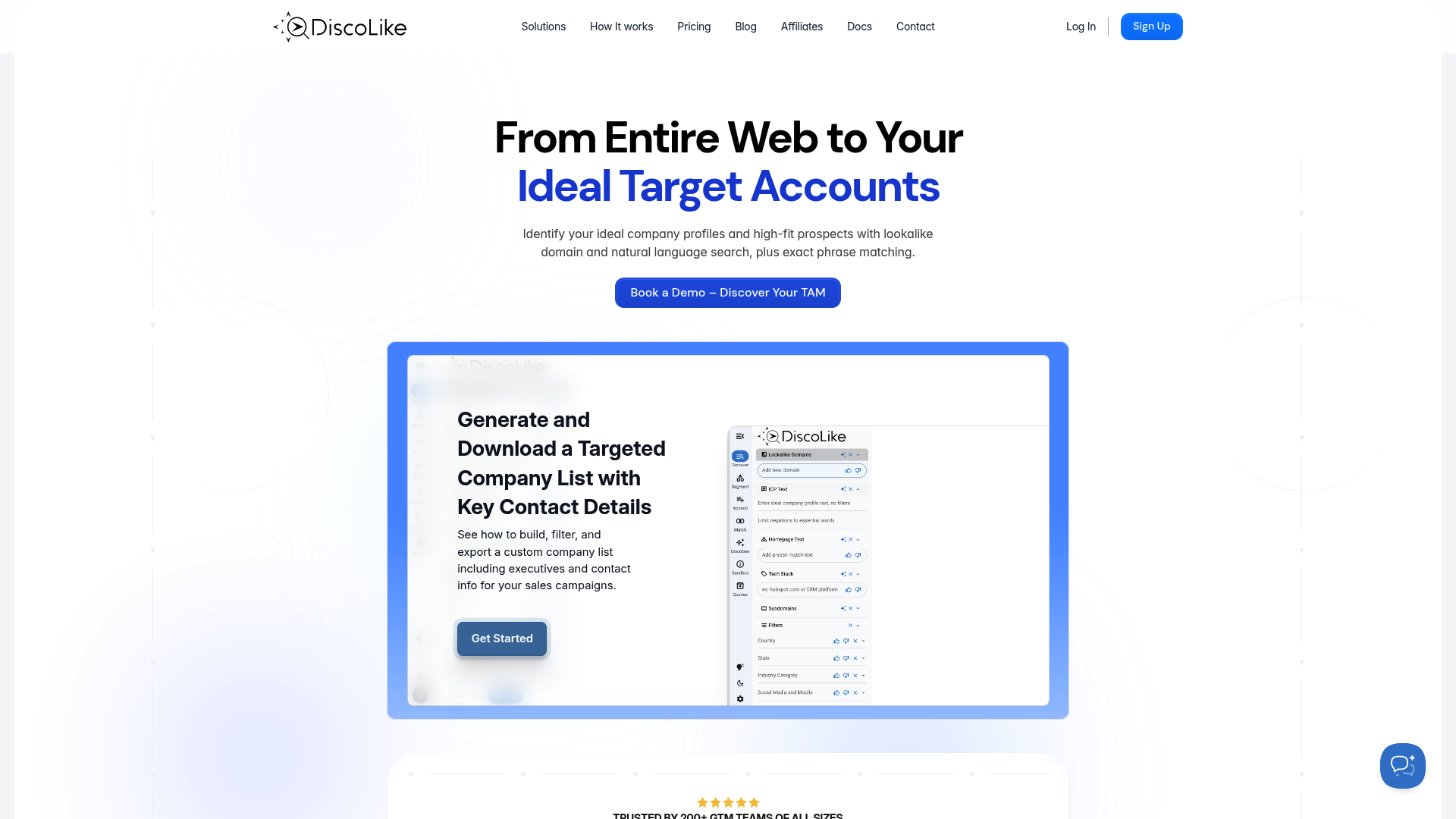
DiscoLike Review 2026: The Revolution of B2B Audience Identification?
TL;DR Summary
- Unique Feature: Website-Level Matching & LLM-based search across 60 million company domains.
- Rating: 4.5/5 – Excellent data coverage, but no public pricing.
- Ideal for: B2B GTM teams, ABM specialists, and cold calling agencies.
Introduction & The Verdict: DiscoLike is a data-driven platform for identifying target customers that differentiates itself from traditional databases by analyzing businesses based on their actual digital footprint rather than rigid LinkedIn labels. By 2026, it will be the tool of choice for teams looking to tap into niche markets underserved by standard tools like Apollo or ZoomInfo. The verdict: A powerful tool for precise prospecting, provided you're willing to inquire about custom enterprise pricing. The Core Problem: Why Traditional Databases Fail: Most B2B sales teams rely on social networks or industry directories. The problem: This data is often outdated, incomplete, or based on self-reported information that doesn't reflect current business realities. Many innovative companies or specialized service providers don't use standard keywords in their profiles, making them invisible to conventional search filters. The solution: DiscoLike's technological approach. DiscoLike solves this problem by using custom LLMs (Large Language Models) trained to understand the text content of over 60 million business websites. Instead of searching by categories, DiscoLike looks for intent and actual service descriptions on the homepage. Website-level matching: The software recognizes exact phrases and content patterns directly on companies' websites. This allows for the identification of companies based on how they describe themselves, not how they have been labeled by third parties. Domain similarity & lookalike search: Users can enter a list of ideal clients, and DiscoLike will find companies with a similar digital footprint. This goes far beyond simple industry codes and analyzes the technological infrastructure as well as content overlaps.
Real Use Cases in 2026
- Precise Account-Based Marketing (ABM): Identifying hidden champions in highly specialized industries.
- TAM Mapping: Complete capture of the Total Addressable Market through analysis of SSL certificates and internet infrastructure.
- Lead Expansion: Supplementing existing CRM data with in-depth technographic insights that go beyond standard providers.
Pricing & Value Analysis Compared
DiscoLike does not currently offer publicly available pricing tiers. The model is primarily based on API access and dataset licensing. In comparison to competitors such as ZoomInfo or Apollo, DiscoLike positions itself as a complementary data source that picks up where social networks leave off. While Apollo focuses heavily on contact information, DiscoLike's strength lies in identifying the right companies (accounts).
Advantages and Disadvantages
Advantages
- Huge database with over 60 million validated companies.
- High accuracy through SSL validation and exclusion of dead domains.
- Unique natural language search.
Disadvantages
- No transparent pricing without a demo request.
- Limited number of independent third-party reviews on portals like G2.
- Focus heavily on data extraction, less on integrated email sending.
Conclusion
Recent (last 90 days)
News & updates
No relevant positive news articles were located for Discolike.
Company
Data-driven target account identification and expansion platform for B2B sales and marketing. Utilizes a proprietary global business domain directory with extensive firmographic, and tech stack data sourced from internet infrastructure rather than traditional social or business networks. Enables natural language and lookalike domain searches across multilingual web content to segment customer lists into precise ideal company profiles and discover high-fit prospects. Provides API access, dataset licensing, and export options for integration with downstream systems, supporting account-based marketing and strategic prospecting.
LinkedIn ↗