

Harmonic
Problem: Investors are missing out on early-stage startups. Solution: Harmonic combines web, network, and CRM data into an AI-powered discovery platform. Result: Faster, more accurate sourcing decisions.
www.harmonic.ai/ ↗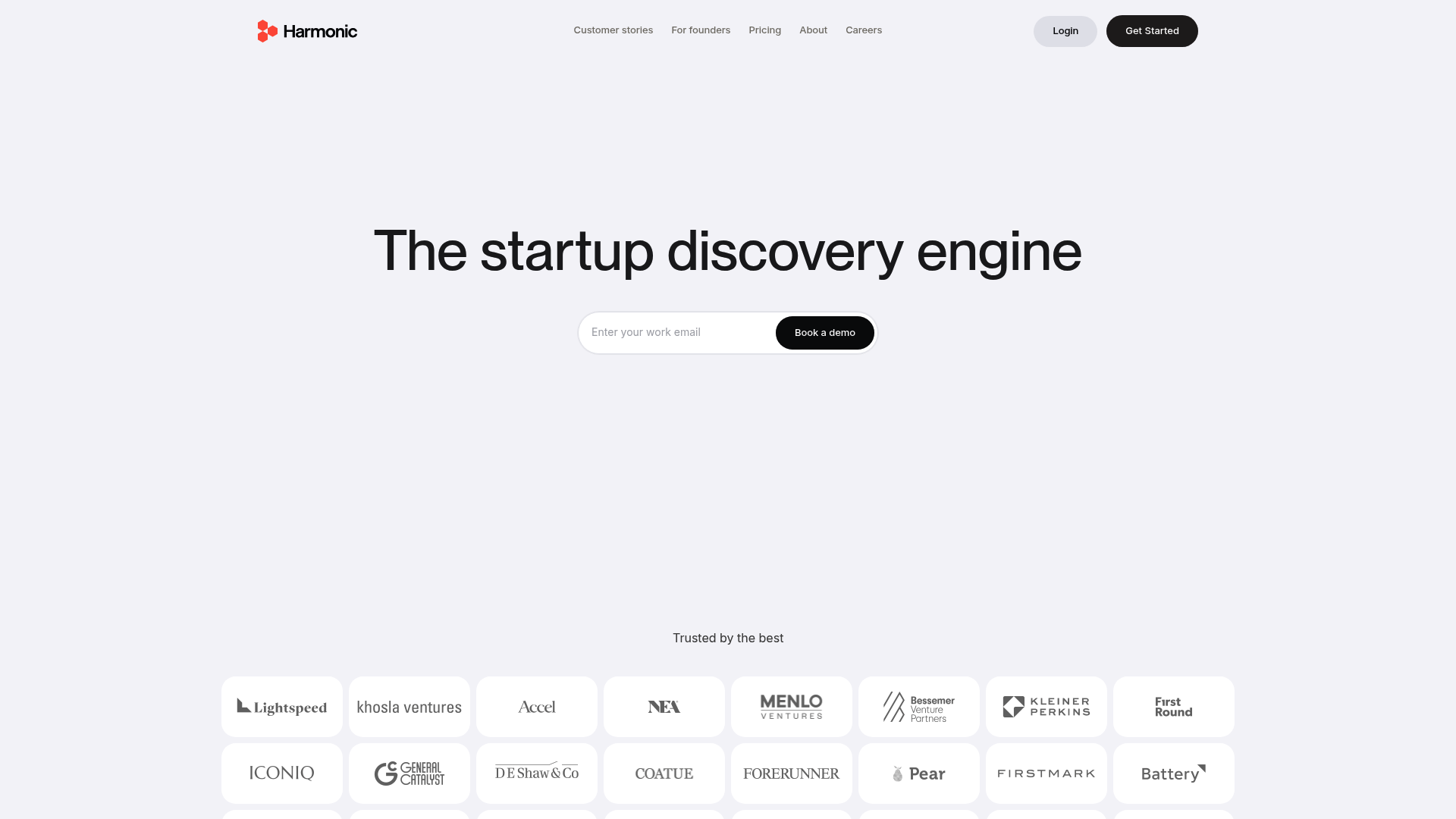
Harmonic Review 2026: The Ultimate Startup Database for Investors and Sales
Unique Feature Rating & Critique: Ideally suited for AI-powered sourcing with over 30 million companies. 4.8/5 - Excellent data quality, but high price for small teams. VC firms, PE investors, and enterprise sales teams.
Introduction & Conclusion
In 2026, Harmonic is the leading platform for discovering early-stage startups. By combining public data, commercial registers, and social signals, it solves the problem of information asymmetry in the investment sector. The bottom line: For data-driven investors looking to find the next unicorn before the competition, Harmonic is an indispensable tool offering the highest precision. The core problem: Finding the needle in the haystack. In a world where thousands of new companies are founded every day, investors and sales teams face a formidable challenge: separating the noise from the relevant information. Traditional databases are often outdated or incomplete. Harmonic addresses precisely this gap through real-time data updates and intelligent filtering. The solution: An intelligent data engine. Harmonic acts as a "source of truth" for the startup world. The platform aggregates data from dozens of sources to paint a complete picture of the market landscape. AI-powered search and filtering. Users can create hyper-specific search queries that go far beyond simple industry categories. Whether it's founder backgrounds, specific technology stacks, or growth metrics – the filter depth is unmatched. Automated Market Analysis: Market maps and talent flows can be visualized with just one click. This allows teams to identify trends before they become mainstream. Seamless CRM Integration: Harmonic integrates directly into existing workflows, whether via Salesforce, HubSpot, or a flexible API (REST/GraphQL). This ensures that the data is available where the decisions are made.
Real Use Cases in 2026
- Venture Capital Sourcing: Identifying stealth startups based on founder departures from tech giants.
- Talent Acquisition: Tracking employee movements in fast-growing sectors to identify top talent.
- Competitive Monitoring: Real-time alerts when competitors close new funding rounds or expand.
Pricing & Value Analysis in Comparison
Compared to competitors like Crunchbase or Apollo.io, Harmonic positions itself in the premium segment. While Crunchbase has a broader scope, Harmonic offers significantly higher data density and specialization in startups.
Comparison with Alternatives
- Crunchbase: Better for general company information, but less depth in early signals.
- Apollo.io: Strong in sales engagement, but weaker in dedicated startup analysis.
- Harmonic: Leader in predicting success potential through aggregated intelligence.
The Result: Increased Efficiency and Higher Deal Quality
Companies using Harmonic report significant time savings in research. Instead of manually maintaining lists, analysts can focus on evaluating opportunities. Automating workflows leads to a higher throughput while simultaneously increasing the quality of contacts.
At a glance
- Industry
- TechnologyInformation and Internet
- Competitors
- CrunchbasePitchBookCB Insights
- Customers
- Tubi, Toast, Coinbase
- Employees
- 77
- Followers
- 27,554
News & updates
The article discusses Harmonic's launch of Aristotle, a pioneering AI model that achieved formal verification at the IMO. It highlights how this model replaces probabilistic reasoning with provable solutions, marking significant advancements in AI capabilities. Harmonic's initiatives are supported by $100 million in Series B funding to further develop AI technologies.
Company
Harmonic is the complete startup database. Used by hundreds of leading investors like Accel, Greylock, and Menlo, as well as GTM teams from the likes of Notion, Google, and Retool to find the best startups and founders. Open roles: https://harmonic.ai/careers
LinkedIn ↗