
Project
Playkind
A voice-first game where kids give instructions to a real robot. Built on Hugging Face LeRobot and the Microduck.
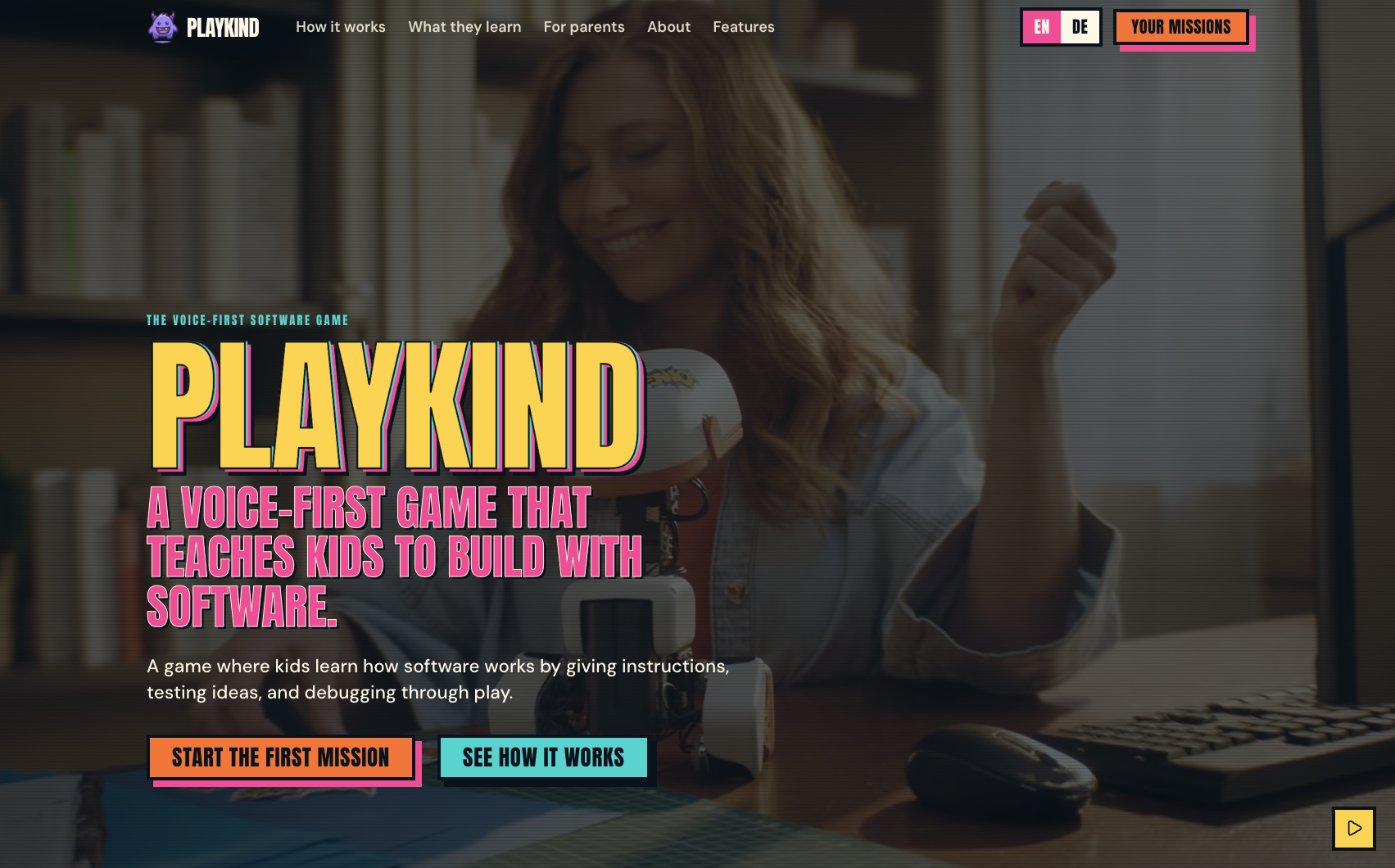
I wanted to know what happens when AI leaves the screen. So I started programming robots: Hugging Face LeRobot as the stack, the Microduck as a small biped that has to walk, fall and get back up.
The experiment turned into Playkind. Kids speak an instruction, the robot executes it, something goes wrong, they debug. That is the entire software loop — without a code editor and without a tutorial.
Balance recovery
Standing up after a fall is the most honest test. The policy runs on-device, feedback is immediate — and that moment is what makes learning tangible for kids.
What I learned
LeRobot as the stack
Data collection, training and inference in one loop. The path from teleoperation to a running policy is shorter than expected.
Microduck as hardware
Two legs, cheap servos, plenty of friction with the real world. Simulation forgives; a living-room floor does not.
Voice instead of interface
Speech is the most natural programming language for kids. The instruction becomes the program, the robot becomes the output.
Debugging as play
When the robot tips over, the bug is visible. Kids correct, retest and learn iteration on the way.
Why this is here
- Robotics forces honesty: either the system runs or it is lying on the floor
- Embodied AI is the step after chat interfaces — I want to know it first-hand
- My kids are the toughest user group I have ever tested with
Take a look
Playkind is open to try. If you work on LeRobot, Microduck or robotics for kids, get in touch.