

Default
Fragmented leads and manual assignment. Default combines routing, enrichment, and appointment booking in one RevOps platform. Result: more meetings, +140% pipeline.
Company snapshot
- Headcount
- 80 (2026-01-01)
- Followers
- 15,955 (2026-06-19)
- HQ
- New York, NY, United States
Headcount growth
Based on LinkedIn data.
Facts
- Industry
- Software Development
- Competitors
- Chili PiperLeanDataRattle
- Customers
- Bloomberry, Oneleet, Ribbon, Aleph, Tremendous, Slipstream Music, Hyperbound, PartnerStack, Peec AI, Candela Medical
- Employees
- 80
- Followers
- 15,955
- Review created
- Last reviewed
Default Review 2026: The All-in-One Revenue Orchestration Platform Put to the Test
In today's sales landscape, companies often face the problem of fragmented tech stacks. Data resides in isolation within CRM systems, appointment booking tools, and enrichment programs. Default positions itself as a central control layer that connects these silos. In this review, we examine whether Default delivers on its promise to fundamentally simplify Revenue Operations (RevOps).
TL;DR: Summary & Verdict
- Unique Feature: Unified data model (single schema) for scheduling, routing, and enrichment.
- Rating: Very good for scaling B2B companies that want to automate complex inbound workflows without tool proliferation.
- Ideally suited for: RevOps teams that want to replace Chili Piper or LeanData with an integrated platform.
What is Default? The Main Problem and the Solution
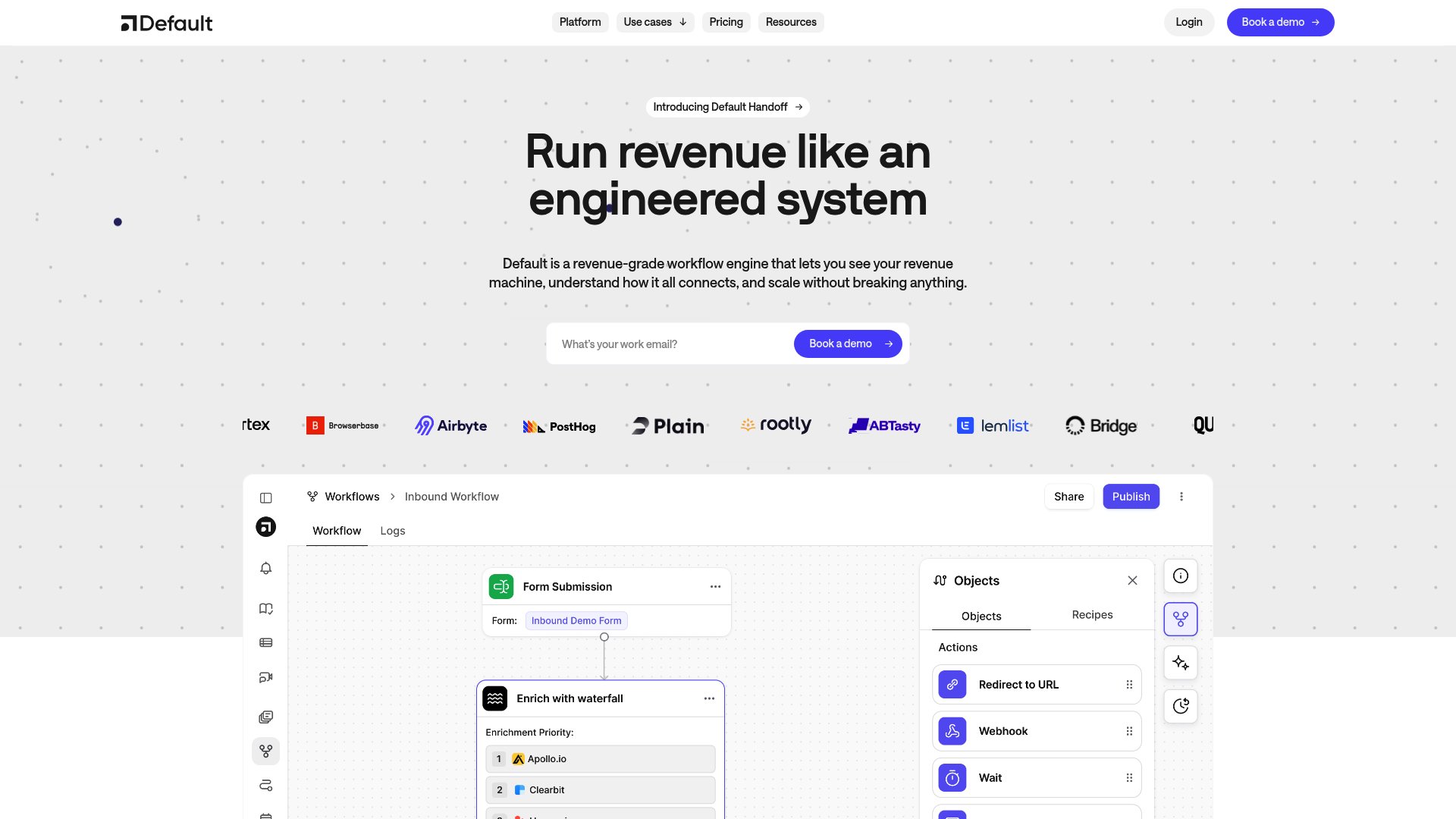
The main problem for many GTM (Go-To-Market) teams in 2026 is "tool fatigue". A lead fills out a form, another tool enriches the data, a third handles the routing, and a fourth the scheduling. If a process changes, the chain breaks at multiple points. Default solves this with an integrated workflow engine. The solution: The Revenue Control Layer. Default acts as the brain behind the tech stack. Instead of point solutions, it offers a canvas (Workflow Canvas) on which forms, data enrichment, and logic loops are defined in a single pass. This reduces latency and ensures consistent data quality in the CRM. Key features of Default: 1. Integrated Scheduling & Routing. Default offers a best-in-class scheduling system that is directly linked to the routing logic. Leads are not only distributed, but immediately assigned to the right contact person based on real-time data from Salesforce or HubSpot.
2. Workflow Orchestration & Enrichment
The platform allows data from third-party providers (enrichment vendors) to be integrated directly into the workflow. A lead is qualified even before they see the calendar. This is done via a unified schema, which minimizes the potential for errors when switching systems.
3. Real-time Monitoring (Logs & Traces)
A key advantage over competitors is transparency. Default offers detailed logs and traces for every single workflow. RevOps managers can see exactly why a lead took a particular path or where an integration is stalling. Practical Use Cases 2026 Inbound Acceleration: Reducing the time from demo request to booked appointment to just a few seconds through instant qualification. Outbound Hand-off: With the new Chrome extension, SDRs can book appointments for AEs directly from the browser, while maintaining all routing rules. Consolidation: Replacing individual solutions like Chili Piper, LeanData, and form builders with a single platform. Competitor Comparison: Default vs. Chili Piper & LeanData
While Chili Piper started as a specialized scheduler and LeanData focuses on complex routing, Default attempts to combine both worlds. The biggest difference lies in the architecture: Default uses a shared data model for all functions, eliminating the need for synchronization between tools.
Pricing Analysis and Value Consideration
Default does not publish fixed pricing tables on its website. Costs are typically tailored to the volume and complexity of workflows. For mid-market startups, consolidating multiple tools often offers a significant ROI, while very small teams must weigh the complexity of implementation.
Conclusion: Is Default Worth It?
Default is more than just a router; it's an infrastructure decision. Companies suffering from a fragmented stack and requiring full control over their revenue logic will find a powerful solution here. The transparency through logs and the speed of implementation (often only 7 days to go-live) are market-leading.
SoftwareApplication & Review Schema (Placeholder)
Here, the structured markup for search engines is implemented to display star ratings and software categories (Revenue Operations Software) directly in the search results.
News & updates
Alorica has been honored with the BIG Innovation Award for its groundbreaking integration of artificial intelligence in customer experience solutions, solidifying its reputation as a leader in innovation within the industry.
Company
Default is a revenue-grade workflow engine that unifies your fragmented tech stack into one, so you can see your entire go-to-market machine, understand how it all connects, and scale without breaking things.
LinkedIn ↗