
AI Monitor
Where does your company
really stand on AI?
Our research project with ETH Zurich and the University of St. Gallen. Measures AI readiness across 6 dimensions, Basis: 165 valid responses from B2B companies.
• Research
A joint research project.
The AI Monitor is a joint research project by Teklens (publisher), ETH Zurich and the University of St. Gallen. We measure AI readiness across six validated dimensions and give you an evidence-based picture of where you stand.
Publisher

Academic partners


AI Monitor 2026 · Readiness Explorer
Where your market really stands.
Six dimensions, 165 responses, one picture. Filter by industry, size or role and compare every segment against the benchmark.
What the data says
AI acceptance stands at 4.0 out of 5, only 5% object. But reconfiguring sits at 2.6, 61% fail to adapt processes after rollout. The workforce wants to. The organisation cannot keep up.
Management support reaches 3.6 out of 5. As soon as resources and vision are at stake, the value drops to 3.3 and 30% land in the bottom third. Leadership commits verbally but does not fund to the same degree.
Internal Assets leads with 60, External Alignment closes with 44, a 16-point gap. Static maturity (people, leadership, tech) was built faster than the ability to adapt and align externally.
Tech Foundation ranges from 62 (Technology & Software) to 15 (Healthcare & Life Sciences), 47 points. No other dimension spreads this far. Where AI meets legacy systems, the technical base collapses.
The 1001-5000 cluster leads in almost every dimension. The very largest (5001-10000) fall behind, partly below the mid-market. More employees do not mean more AI maturity, rather the opposite.
40% rate themselves largely compliant with the EU AI Act. Of those, 41% have weak operational governance (≤3 out of 5). Self-assessment runs ahead of practice.
Key findings
Internal Assets · 59.6
Strongest dimension (60). AI acceptance and culture reach 4.0 out of 5, only 5% are opposed. The will is there. Talent and cross-functional collaboration lag at 3.1, culture is ahead of structure.
External Alignment · 44.1
Weakest dimension (44). Ecosystem connections (2.7), ethics governance (2.8) and the EU AI Act (2.9) are the least developed. 43% rate themselves strong on the AI Act, mostly without operational governance behind it. Compliance is declared, not embedded.
Basis: 165 valid responses (106 with demographic data), AI Monitor 2026, ETH Zurich / University of St. Gallen. Values are self-assessments normalised to 0-100. Industry and size segments are small; read as a direction.
• Glimpses
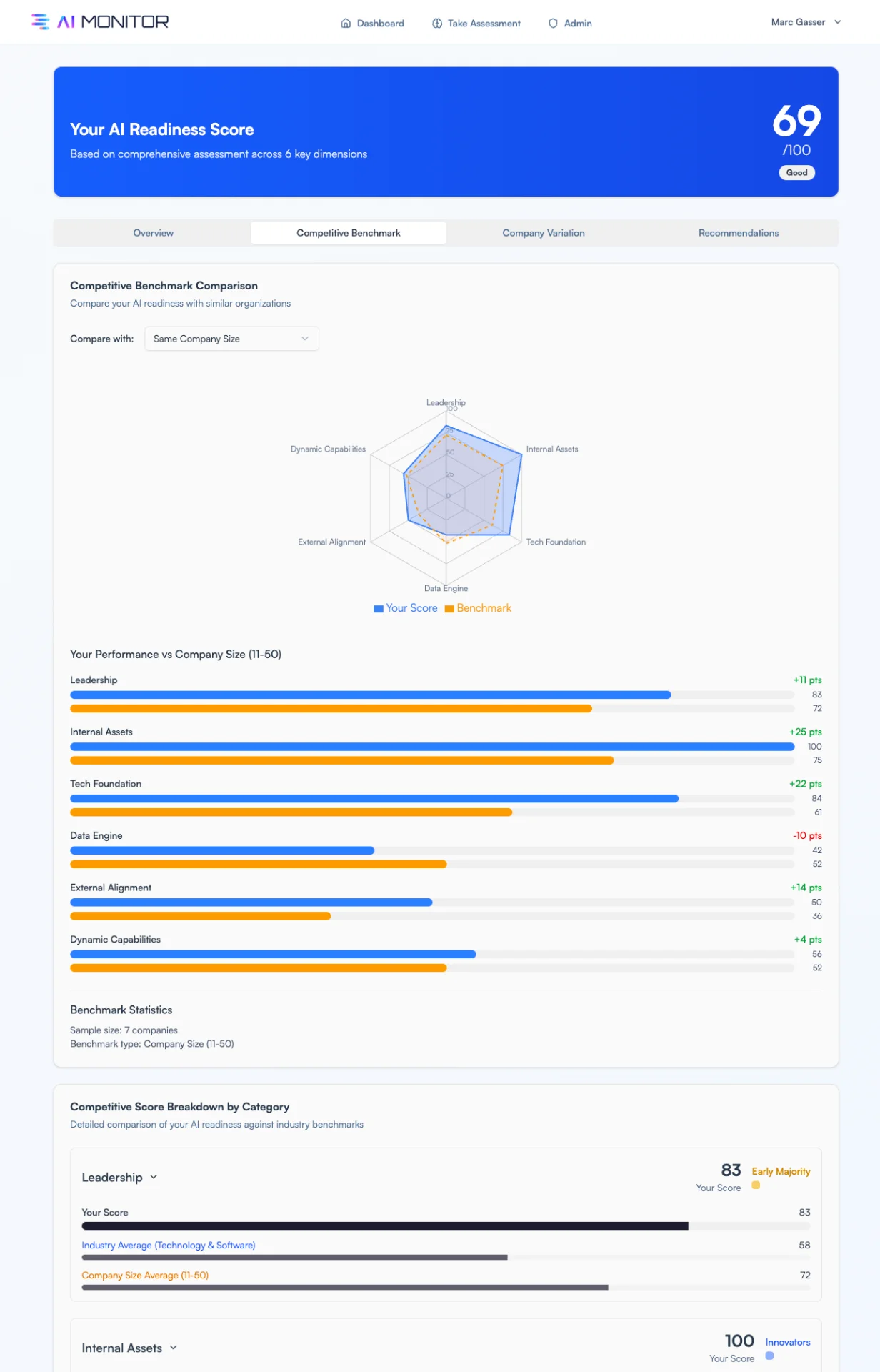
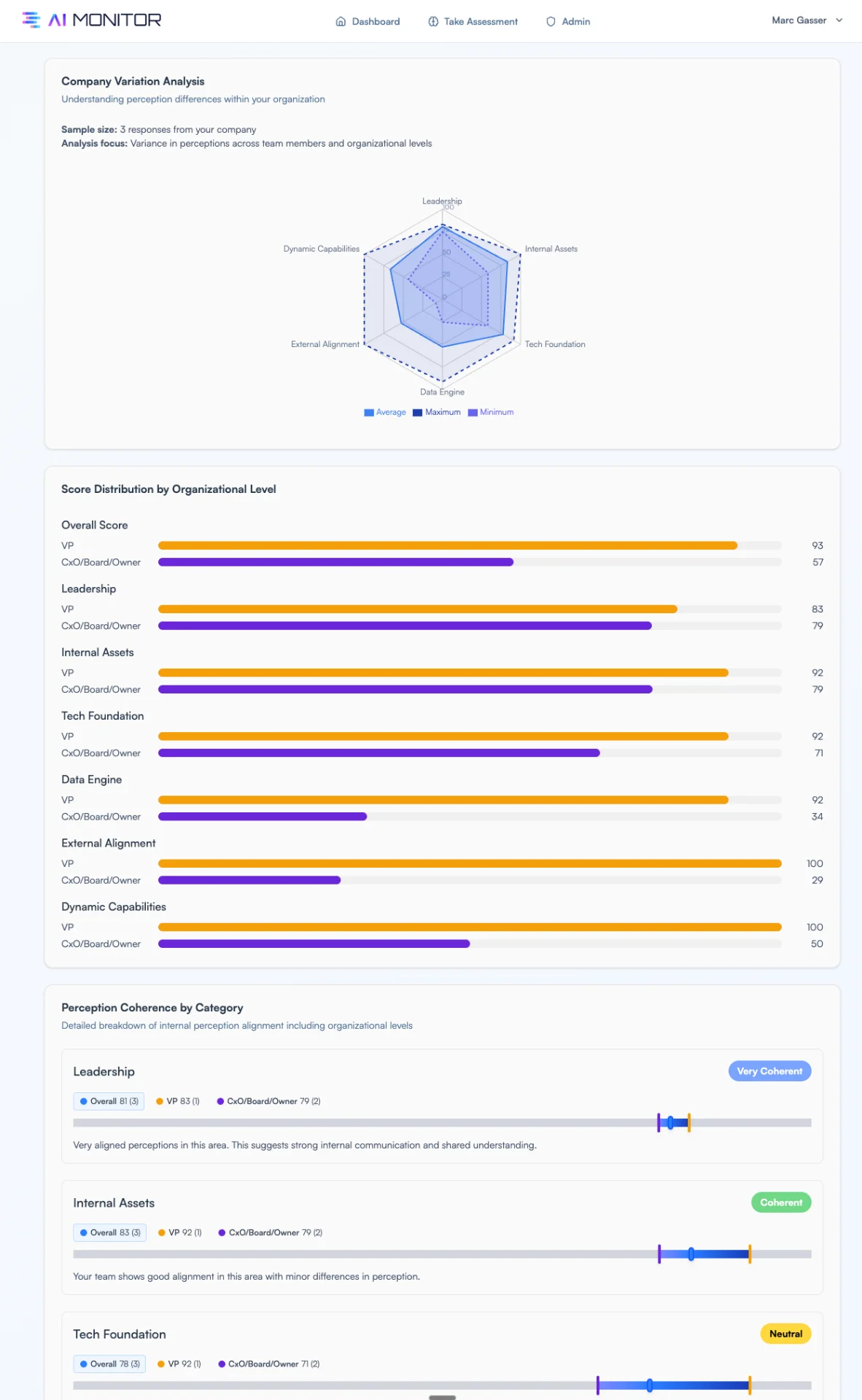
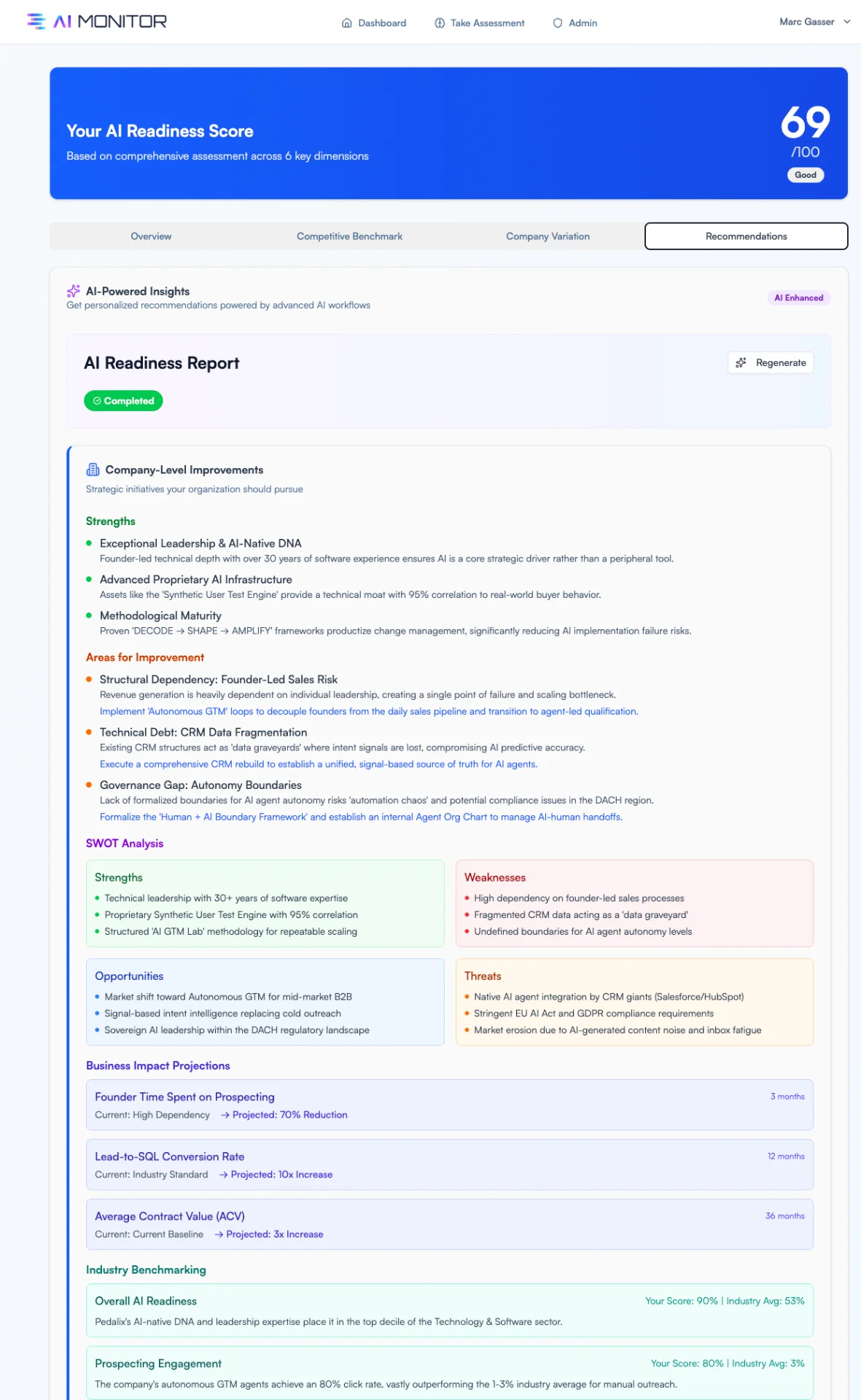
What the interactive report looks like.
Three excerpts from the latest report.
Ready to find out where you really stand?
15 minutes. 6 dimensions. One clear picture.