

Domo
Domo unifies fragmented data into a single platform. AI agents automate workflows and deliver precise insights to make smarter business decisions.
www.domo.com ↗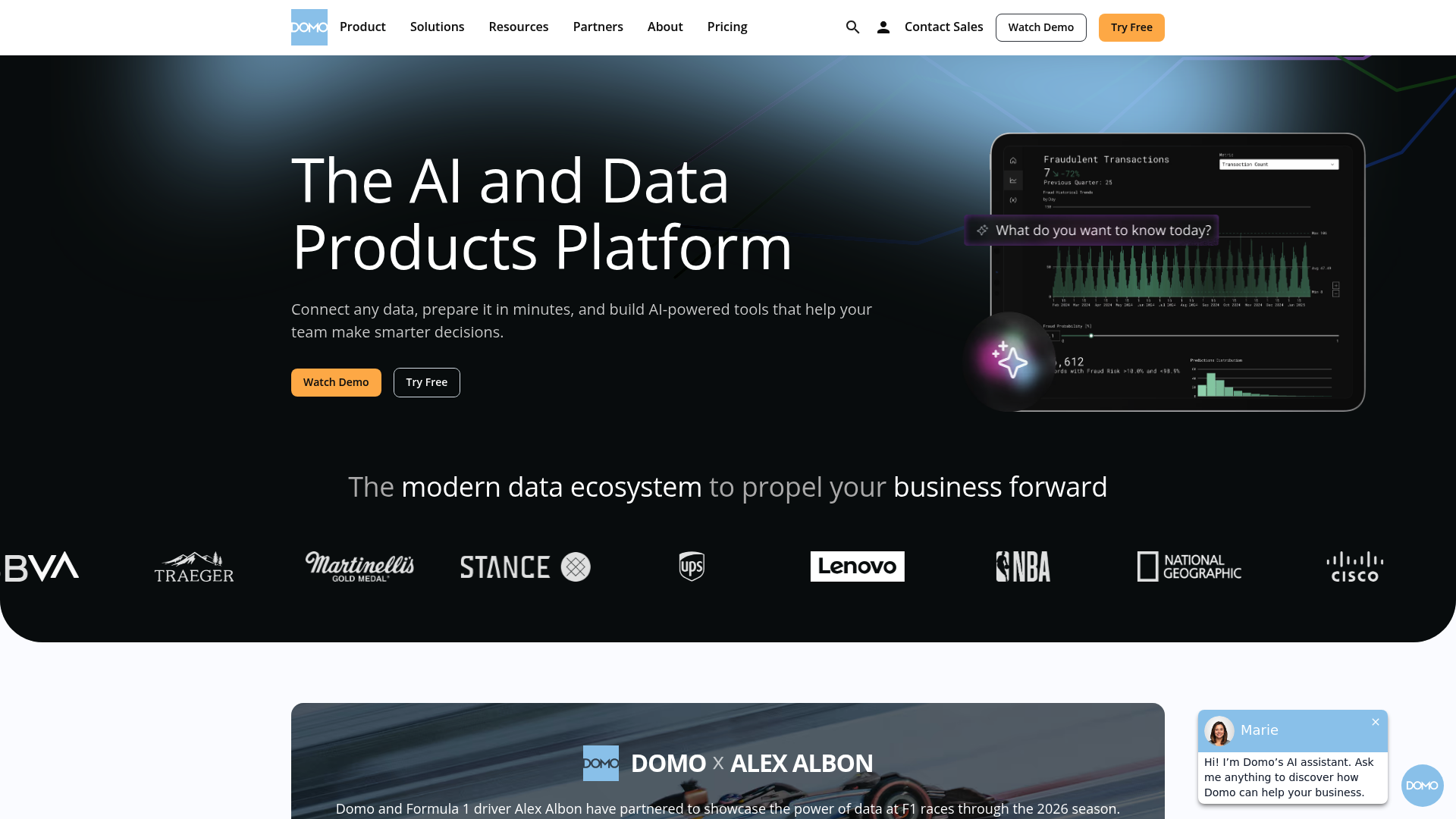
Domo Review 2026: The Ultimate Platform for AI-Powered Data Products?
Unique Feature Rating & Critique Best suited for Domo.AI & Agents 4.5/5 (Gartner) - Strong in automation Teams that need AI workflows without coding 1,000+ data connectors 4.3/5 (G2) - High integration power Companies with complex data landscapes Low-Code App Studio 4/5 - Flexible, but with a learning curve Product teams for internal data apps
Introduction & Conclusion
Domo combines data integration (1,000+ connectors), ETL, low-code app creation, and AI agents into a comprehensive enterprise platform. The system is particularly strong in integrated automation and embedded analytics. It is ideal for medium-sized and large companies that want to scale data products. Potential disadvantages include opaque pricing and higher implementation complexity compared to pure BI tools.
Core AI Functions and Unique Selling Points
Domo.AI and Agentic Workflows
Domo has evolved from a pure dashboard tool to an AI platform. With Domo.AI, companies can deploy specialized AI agents that autonomously perform tasks such as HR benefit analyses or competitor research. These agents are not just chatbots, but operate directly on the integrated data streams.
Massive Connectivity
With over 1,000 native connectors, Domo solves the problem of data silos. Whether cloud storage like Snowflake and AWS or on-premises systems – the platform centralizes information in real time, drastically reducing manual data preparation. Low-Code App Studio: The App Studio allows business units to build their own data apps without in-depth programming knowledge. This promotes the democratization of data across the entire company. Practical Use Cases 2026: In today's business world, companies primarily use Domo to automate decision-making cycles. For example, a retailer can have AI agents monitor inventory levels, automatically triggering reorders when shortages occur. In the financial sector, Domo helps generate complex compliance reports in minutes instead of days through automated ETL processes. Pricing & Value Analysis in Comparison
Compared to Microsoft Power BI or Tableau, Domo positions itself as a premium solution. While Power BI scores points through its integration into the Microsoft ecosystem, Domo offers deeper integration of app development and AI automation in a single interface. However, pricing is not publicly available and requires contact with sales, which can be a hurdle for smaller teams. The return on investment (ROI) here is primarily achieved through the savings in labor hours for data management.
At a glance
- Industry
- Software Development
- Competitors
- TableauMicrosoft Power BILooker
- Customers
- Lenovo, Panasonic, Schnucks
- Employees
- 1,325
- Followers
- 173,139
News & updates
Domo was awarded the CRN 2025 Products of the Year Award for its AI and Data Products Platform, which highlights its effectiveness in business intelligence and analytics, demonstrating significant impact on customer performance.
Company
Strengthen your entire data journey with Domo’s AI and data products. Connect and move data from any source, prepare and expand data access for exploration, and accelerate business-critical insights.
LinkedIn ↗