

Storydoc
Static PDFs convert poorly. Storydoc offers interactive, AI-powered presentations with tracking that complete up to 30% faster and increase customer acquisition by 70%.
www.storydoc.com/ ↗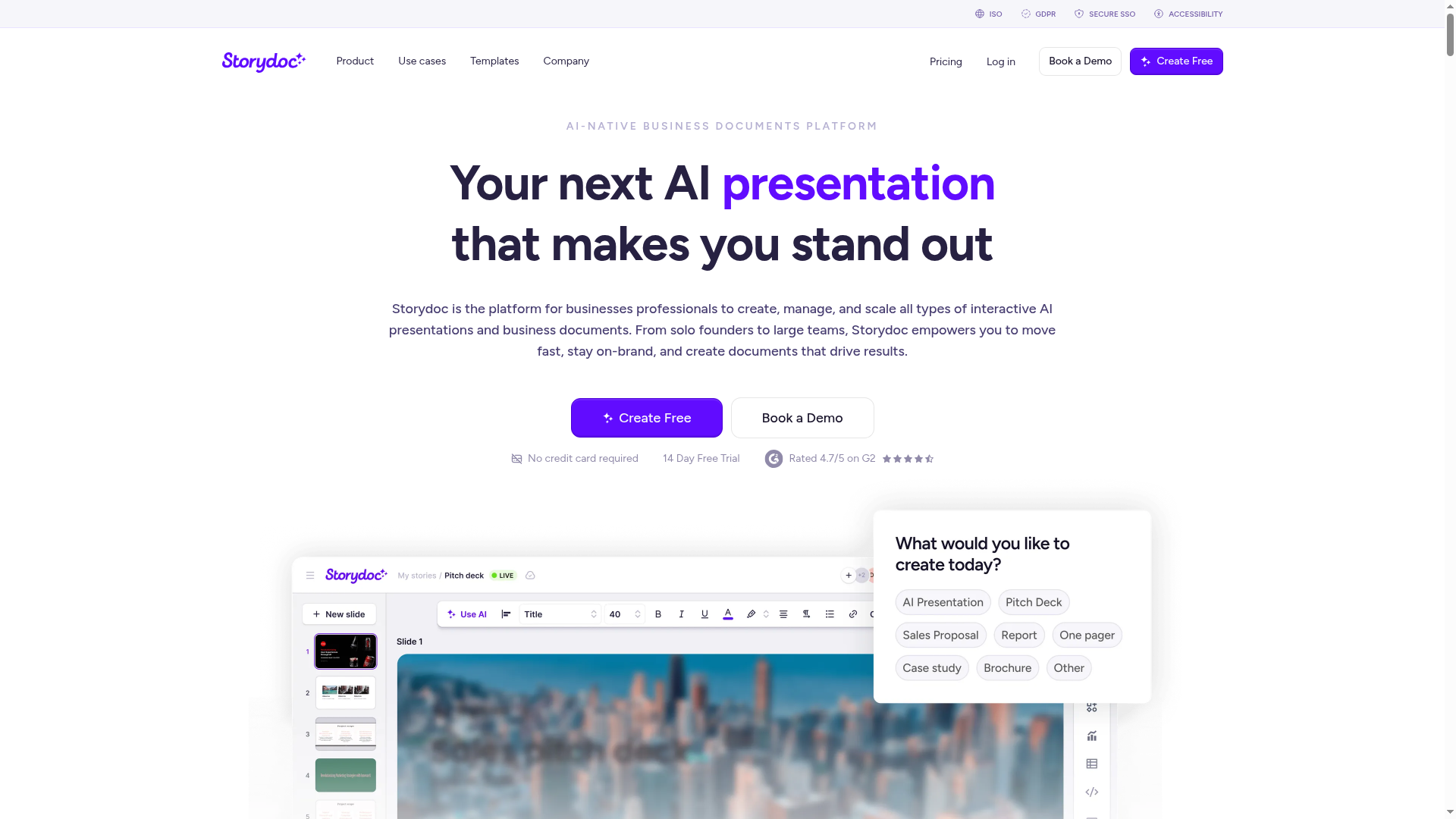
Storydoc Review 2026: The Revolution of Interactive Business Presentations In a world where static PDFs and PowerPoint slides often disappear unread into inboxes, Storydoc promises an interactive solution. This review explores how the software, with its AI support and real-time analytics, is transforming B2B communication. TL;DR Summary Unique Feature: Interactive no-code editor with AI content creation and CRM live data integration. Rating: 4.8/5 – Excellent for sales teams; From a critical perspective, the dependence on the online platform is a factor. Ideally suited for: Sales, Marketing, and Investor Relations, which require measurable interaction instead of static documents. Introduction & The Verdict Storydoc addresses the core problem of modern business communication: the lack of attention. While classic decks are often ignored, Storydoc offers a web-based, mobile-optimized alternative. The verdict for 2026: It's the essential tool for teams looking to significantly increase their closing rates through data-driven personalization and interactive storytelling. The Main Problem: Death by PowerPoint Companies invest hours in presentations but never know if the recipient read page 5 or closed the document immediately. Static formats offer no interaction, no trackability, and adapt poorly to mobile devices. This leads to slow sales cycles and missed opportunities.
The solution: Interactive Storydocs
Storydoc replaces the file with a smart link. The software offers an intuitive editor that requires no prior design knowledge.
AI-powered creation
With the help of artificial intelligence, complete, structured business documents can be generated from simple prompts. The AI not only handles the layout but also suggests relevant content.
CRM integration & personalization
By connecting to systems like Salesforce or HubSpot, documents are automatically personalized with customer data. This happens in seconds and enables scaling that would be impossible manually.
Core Features for 2026
Real-time Analytics
Users see exactly who opened which document and when, how long they stayed on each page, and which elements (CTAs) were clicked. This allows for precise follow-up at precisely the right moment.
Embedded Interactions
Instead of linking to external pages, Calendly appointment bookings, videos, and interactive forms can be embedded directly into the document. The reader never has to leave the presentation to convert.
Results: What does Storydoc really deliver?
The real-world figures are clear. Users report a 21% increase in reading time and a 41% higher likelihood of reading a document in its entirety. In sales scenarios, this often leads to a doubling of booked meetings and a significant increase in conversion rates (up to a 10% CTA rate).
Use cases in 2026
- Sales Proposals: Automated, highly personalized offers that accelerate the decision-making process.
- Investor Relations: Interactive pitch decks that make investor engagement measurable.
- Annual Reports: Complex data becomes tangible and understandable through interactive visualizations.
Price-performance analysis & Competition
Compared to static tools like Canva or PowerPoint, Storydoc is priced in the premium segment for businesses, but offers a clear ROI thanks to its analytics. There's a 14-day free trial without a credit card to test the features of the Starter plan. While PowerPoint remains the go-to tool for internal notes, Storydoc is the standard for customer-facing communication.
Conclusion: Is it worth switching?
For teams that rely on performance, the answer is a resounding yes. The combination of AI efficiency and deep insights into user behavior makes Storydoc a powerful ally in the B2B sector. Those willing to shift their workflow from 'files' to 'experiences' will be rewarded with higher conversion rates.
At a glance
- Industry
- TechnologyInformation and Internet
- Competitors
- PitchCanvaQwilr
- Customers
- Meta, Cashkum, Facebook
- Employees
- 21
- Followers
- 1,696
News & updates
Storypod received the prestigious 2023 PAL Award, which highlights its contributions to stimulating language development and the magic of storytelling. The company is honored by this recognition and it's a testament to their innovative approach in educational storytelling.
Company
Storydoc is an intuitive slide editor that creates interactive presentations that impress your leads. It makes it easy to replace static PDFs with engaging decks created exclusively for sales and marketing teams. Storydocs are proven to push leads to the next step, helping you to win more deals in less time. Every Storydoc is packed with powerful integrations, seamlessly connecting to your CRM and automatically personalizing your decks for each customer.
LinkedIn ↗