

Acho
Problem: Companies use scattered, isolated Excel solutions. Solution: Acho offers customizable business apps with automation. Result: Processes are automated and scalable.
Company snapshot
- Headcount
- 62 (2026-08-13)
- Followers
- 5,749 (2026-08-13)
- HQ
- San Francisco, CA, United States
Headcount growth
Based on LinkedIn data.
Acho's GTM, reverse-engineered
Why is Acho growing so fast?
Acho's growth is primarily driven by a product-led acquisition model targeted at data workers. The company leverages a freemium website funnel that removes initial friction, leading into a seat-based SaaS monetization structure. This systematic approach, initially kickstarted by founder-led network effects from Y Combinator and earned media, correlates with a 244% headcount expansion over a recent 12-month period.
Headcount: 18 → 62 (+244% / 12M, 2026-08-13) · baseline partly interpolated
Freemium Product-Led Acquisition
Supported inferenceProduct-ledIndividuals discover the platform and adopt the tool via a self-serve Free plan. This removes initial friction for data workers to build their first workflows before hitting a paywall.
Tiered Seat-Based Monetization
ObservedProduct-led salesMonetization follows a seat-based SaaS model tiered by creator capabilities and usage limits. Pricing scales from the free tier to a paid Creator seat, culminating in custom enterprise packages for organisations requiring advanced security.
Founder-Led Network Kickstart
Supported inferenceFounder-ledEarly acquisition relied heavily on founder-led network effects stemming from Y Combinator participation in 2020. This was amplified by strategic earned media during their $2.2M seed round in 2022.
Evidence-based GTM analysis (GTM-RX). Observations, company claims and inferences are labelled separately. 3 sources. Updated: 2026-08-28.
Facts
- Pricing
- Freemium
- Industry
- TechnologyInformation and Internet
- Competitors
- RetoolWorkatoQuickbase
- Customers
- Harbor Compliance, Boston Scientific, CarDoor
- Employees
- 62
- Followers
- 5,749
- Review created
- Last reviewed
Acho Review 2026: The All-in-One Platform for Data-Driven Business Apps
- Unique Feature: AI-Powered Data App Builder with Event Broker
- Rating: 4.5/5 - Powerful for data teams, requires training
- Best for: Startups and companies that want to turn data into operational workflows
Introduction & Verdict: Is Acho the Solution to Data Chaos?
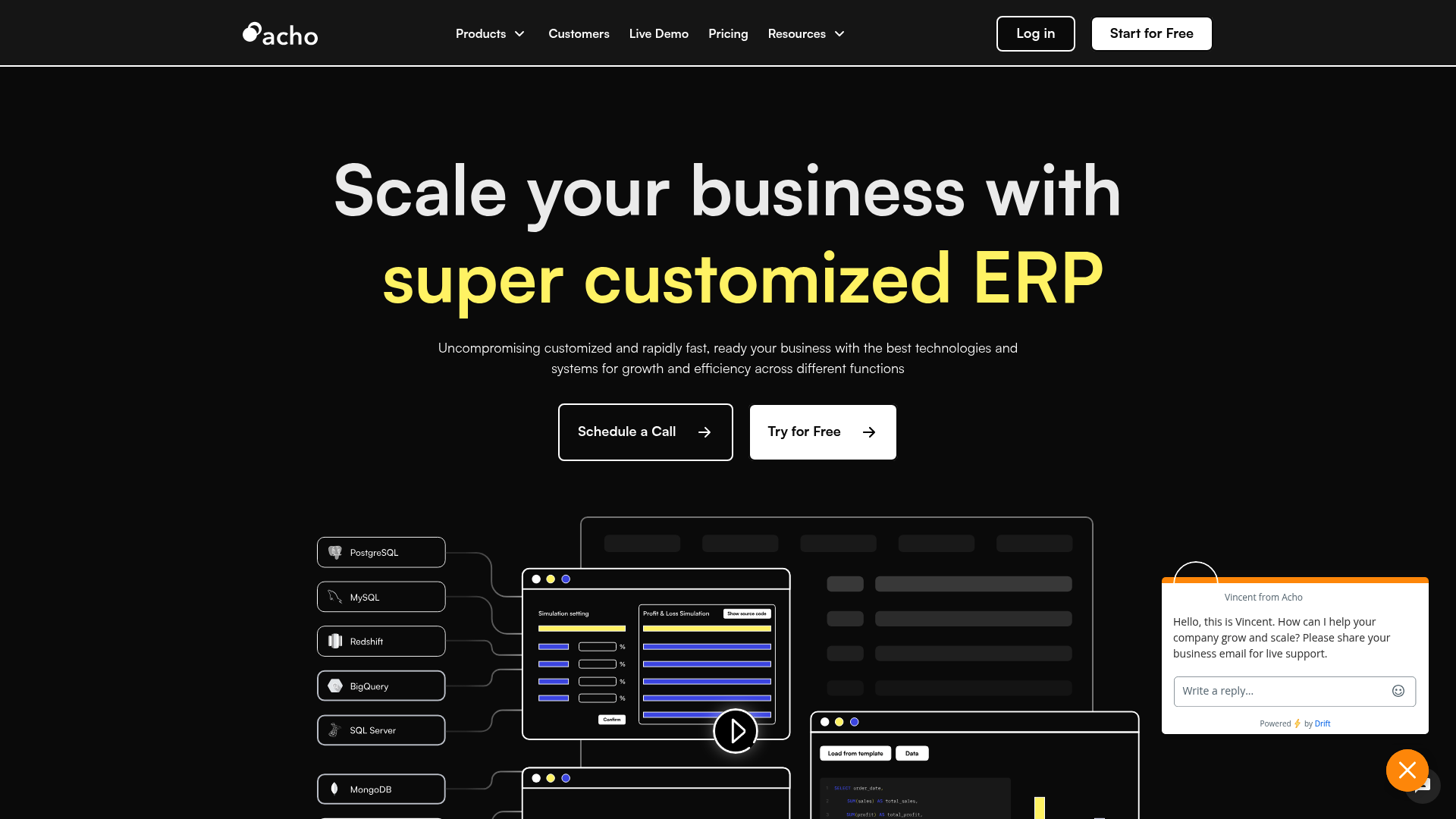
Acho is a low-code platform that enables companies to transform fragmented data sources into functional business applications. In 2026, Acho will be at the forefront of the movement not only to analyze data, but to make it directly productive through automation and AI support. It is an ideal tool for teams that want to build complex ERP-like software or internal tools without significant IT resources. The core problem: Data silos and development bottlenecks. Many companies suffer from scattered data in CSV files, APIs, and SQL databases. Manual preparation is time-consuming, and developing custom software solutions by IT departments often takes months. Acho addresses precisely this pain point by bridging the gap between raw data and finished applications. The solution: A modular data application architecture. Acho offers an integrated environment where data is connected, transformed, and visualized. The platform utilizes ASSEMBLE technology (AI-powered, Serverless, Scalable, Event-driven, Business Logics Engine) to map the entire lifecycle of a data application. AI-powered SQL generation: With the AI Engine, users can formulate complex database queries in natural language. The system automatically generates the appropriate SQL code, significantly lowering the barrier to entry for non-technical staff. Visual App Builder: Drag-and-drop components allow users to create user interfaces for dashboards, CRM systems, or inventory management tools. Templates significantly accelerate the process. Event Broker & Automation: The Event Broker enables workflows to be triggered based on data changes. For example, automatic notifications or RPA (Robotic Process Automation) processes can be started without manual intervention. Practical Use Cases in 2026: Real-time supply chain monitoring: Connecting supplier data via API for automatic inventory optimization. Customer-facing portals: Providing individual dashboards for external customers based on internal databases. Automated financial reports: Consolidating various payment providers into a central reporting app. Price and value analysis comparison: Acho offers a tiered model, starting with a free version for beginners. Compared to competitors like Retool or Appsmith, Acho places a stronger emphasis on data processing and event handling. Free Forever: 5 app users, 5 GB data processing, basic connectors. Creator ($75/month): 50 GB data processing, unlimited connectors, advanced automation. Enterprise: Custom pricing, on-premises hosting, dedicated support, and the highest compliance standards (GDPR, SOC II, HIPAA). Step-by-step: From CSV to App. Connecting a data source: Upload a file or link to an SQL database. Transformation: Using AI to clean or aggregate data. UI Design: Selecting table and chart components in the builder. Deployment: Publishing the app to the team or external users. Conclusion: Strengths and Weaknesses. Acho is a powerful platform for "productizing" data. Its strengths lie in rapid prototyping and deep AI integration. A potential drawback is its reliance on a proprietary platform (vendor lock-in). Nevertheless, Acho offers an invaluable speed advantage for modern, data-driven businesses.
Structured Data (Schema Representation)
- Type: SoftwareApplication
- Name: Acho
- ApplicationCategory: BusinessApplication
- OperatingSystem: Web-based
- Rating: 4.5
- Price: 0 - Custom
News & updates
The award highlights Accolade's unique approach that combines AI with human empathy to enhance healthcare experiences, demonstrating strong consumer satisfaction and ethical practices in using AI.
Company
Aden Technologies is building the next generation of AI-native observability: designed for teams building, operating, and scaling autonomous agents. Our intelligent platform connects engineering performance with financial unit economics into one adaptive system, giving CTOs and CFOs real-time clarity into where every token, API call, and dollar creates the most business value. With Active Governance, Aden transforms passive monitoring into intelligent feedback loops - optimizing gross margins, preventing runaway loops, and automating departmental chargebacks. From sub-millisecond circuit breakers to forensic audit trails, Aden makes AI infrastructure spend faster, smarter, and measurable. Trusted by forward-thinking teams across the AI infrastructure and vertical agent sectors, Aden helps companies scale responsibly - turning raw token data into financial direction, and AI operations into a competitive advantage.
LinkedIn ↗