

Alan AI
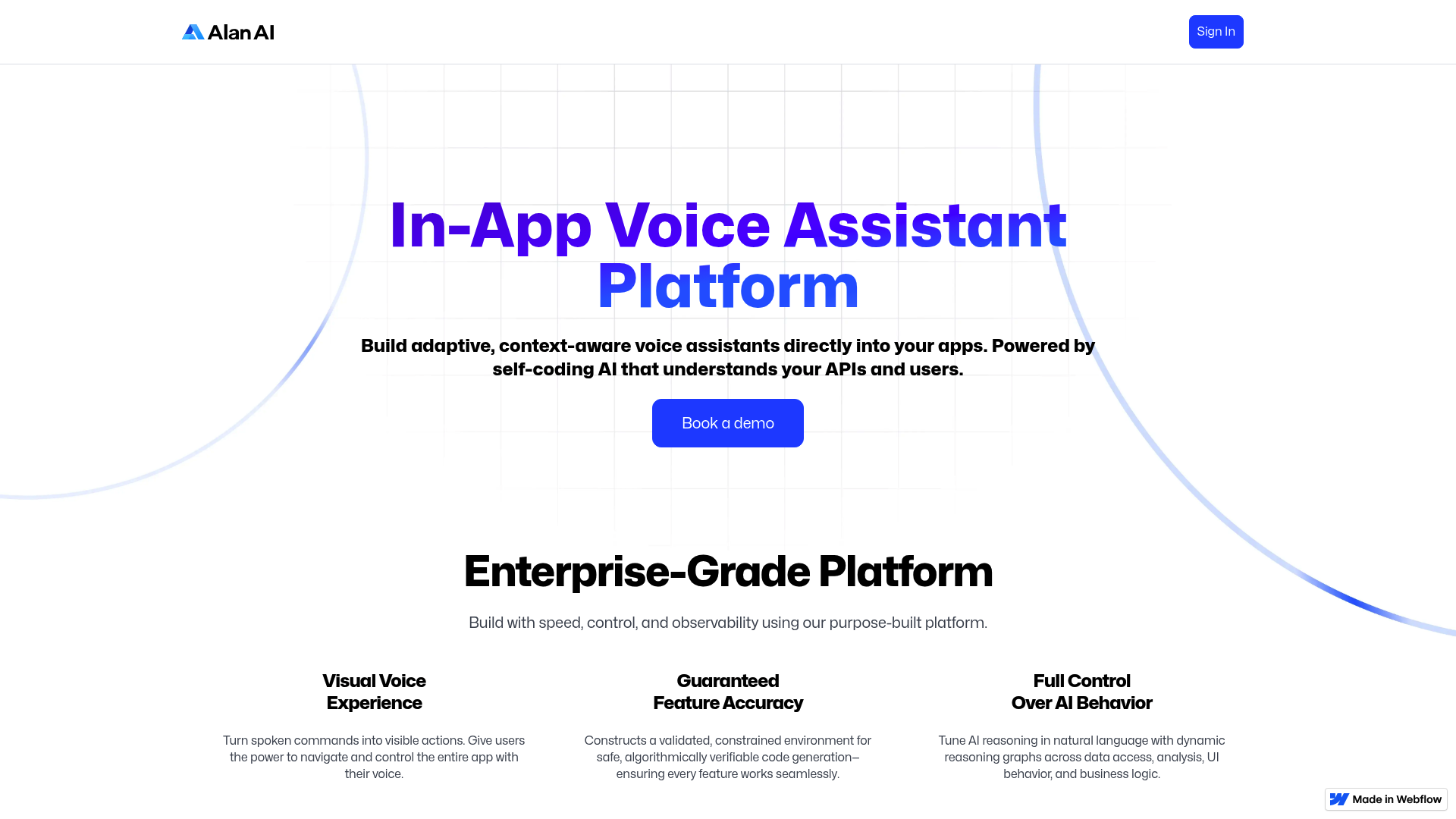
Alan AI solves complex app operation through AI voice control that interacts directly with APIs. The result: intuitive navigation and increased user efficiency.
Company snapshot
- Headcount
- 27 (2026-08-13)
- Followers
- 4,382 (2026-08-13)
- HQ
- Los Altos, California, United States
Headcount growth
Based on LinkedIn data.
Facts
- Industry
- IT Services and IT Consulting
- Competitors
- AtolioGleanVectara
- Customers
- No customers found
- Employees
- 27
- Followers
- 4,382
- Review created
- Last reviewed
Alan AI Review 2026: The In-App Agent Revolution Put to the Test
- Unique Feature: Three-Layer AI (3LAI) architecture for real-time UI generation.
- Rating & Critique: 4.8/5 – Excellent integration, but requires precise API structures.
- Ideally suited for: Enterprise apps that want to automate complex workflows via voice/text.
Introduction & Conclusion: Is Alan AI the future of app interaction?
Alan AI is an intelligent platform for in-app agents that makes it possible to control complex software using natural language. By combining business logic and UI context, Alan AI solves the problem of rigid menu navigation. The result is increased user engagement and more efficient workflows in enterprise applications.
Core Features of the AI Platform
Visual Voice: Speech Becomes Action
At the heart of Alan AI is its ability to directly translate spoken commands into visible actions within the app. Unlike simple chatbots, the system understands the user's current screen context.
The Three-Layer AI (3LAI) Architecture
Alan AI utilizes a proprietary architecture that connects three layers: the presentation layer (GUI), the business logic, and data management. This allows the AI to dynamically generate code snippets and UI elements.
Alan AI Studio & SDK
Developers use the web-based studio as an IDE for dialog design. With the cross-platform SDKs, the intelligence can be integrated into existing iOS, Android, or web apps in just a few days.
Practical Use Cases 2026
- Healthcare: Hands-free documentation for medical staff during treatment.
- E-commerce: Complex product filtering and purchase processing through simple voice commands.
- Logistics: Voice-controlled inventory and route optimization in real time.
Price & Value Analysis Comparison
Alan AI offers a flexible model. While smaller projects have pay-as-you-go options, enterprise solutions rely on individual contracts. Compared to competitors like Google Dialogflow or Voiceflow, Alan AI scores points with its deeper app integration, while other tools often function only as isolated chat overlays. Advantages: Fast time-to-market (integration in days). High security through VPC and air-gapped options. Support for multiple LLMs (OpenAI, Anthropic, Open Source). Challenges: Requires clean API documentation of the host app. Learning curve for complex dialogue scripts in the studio.
News & updates
The winners of the Alan Voice AI Hackathon impressed with their exceptional voice-enabled applications, promoting inclusivity and enhancing quality of life for diverse community members. The competition highlighted the innovative spirit of participants and the positive impact of voice technology in accessible education and health.
Company
Alan AI transforms enterprise software with a new approach, Adaptive App AI. Instead of relying on manual development or isolated AI tools, we embed an intelligent layer into your application that builds features on demand. Powered by our proprietaryThree-Layer AI (3LAI) architecture, our system generates business logic and UI in real time, with less reliance on developers. It works across your entire app stack: the user interface, business logic, and data management. Our Product – The Intelligent App Platform TheIntelligent App Platform lets companies integrate agentic interfaces into their existing apps in days, not months. It creates a constrained and validated environment from your app’s APIs, GUIs, and documentation, enabling AI for accurate, context-aware code generation. At runtime, the AI acts like a self-coding engine—instantly creating new features based on user needs. Alan AI takes an agnostic approach to models, data, cloud, and applications, giving customers freedom of choice.
LinkedIn ↗