

Clay
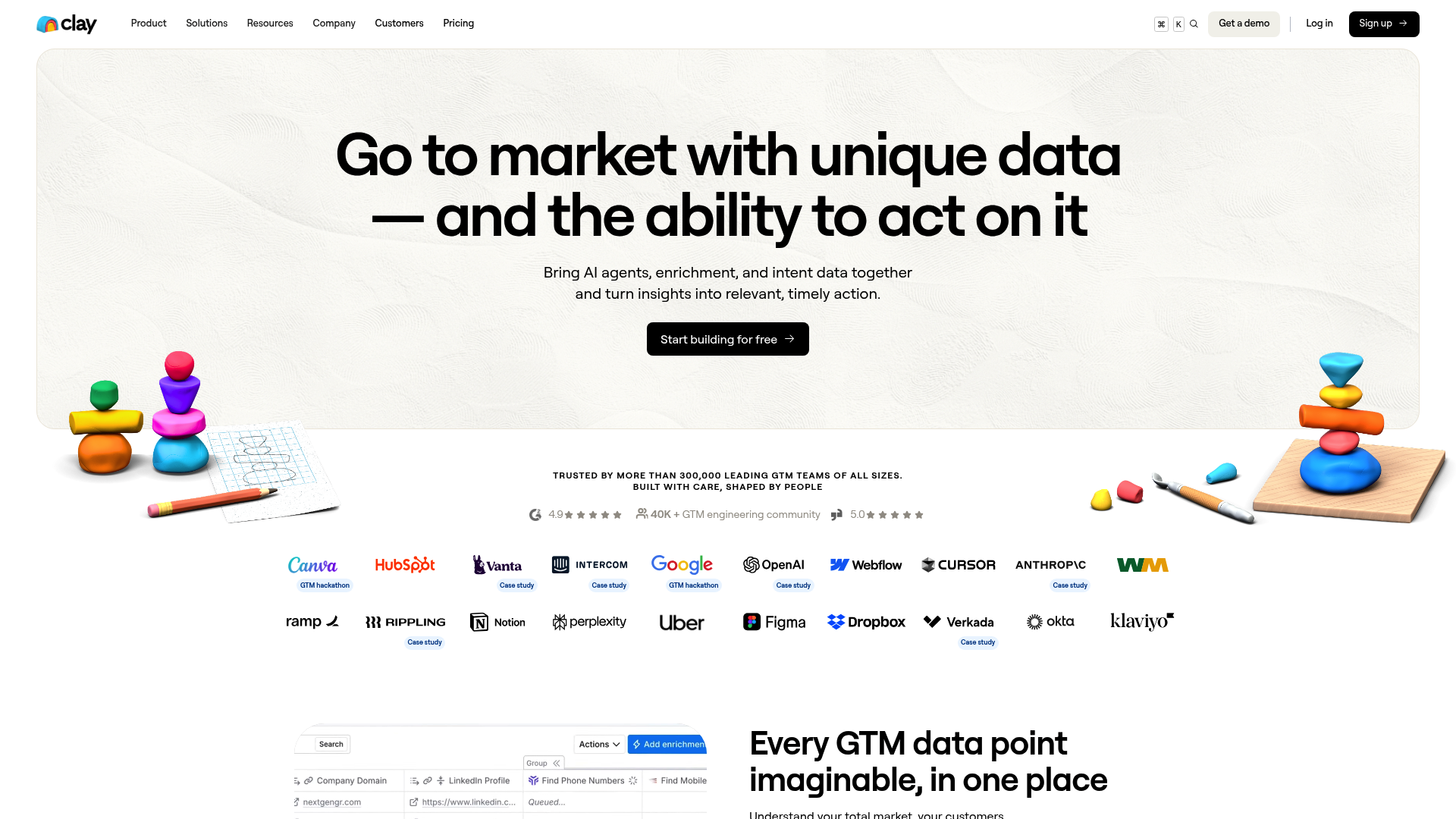
Clay combines AI agents, enrichment from 150+ data sources, and workflows to transform scattered GTM data into instantly usable, accurate leads.
Company snapshot
- Headcount
- 1,094 (2026-01-01)
- Followers
- 168,987 (2026-06-19)
- HQ
- New York, NY
Headcount growth
Based on LinkedIn data.
Clay's GTM, reverse-engineered
Why is Clay growing so fast?
Clay is scaling rapidly by aligning a self-serve product with a credit-based pricing model. Users begin with free data enrichment tasks and naturally consume more credits as their outbound campaigns expand. This expansion is backed by continuous funding and an observed 109 percent headcount increase over 12 months.
Headcount: 523 → 1094 (+109% / 12M, 2026-01-01)
Credit-based monetisation
Supported inferenceClay uses a freemium model that enables users to test enrichment capabilities before committing. Monetisation and expansion are directly tied to usage limits via a credit system. As GTM campaigns require higher lead volumes, users naturaly upgrade their tiers.
Self-serve product wedge
Supported inferenceThe platform allows users to start with specific list-building tasks and expand into complex outbound campaigns. This workflow deployment loop encourages users to build additional automations once the initial process is successful.
Category creation
Company claimClay positions itself away from simple data provision towards an AI-powered platform. Recent messaging from the company emphasises the creation of a new category termed GTM Engineering.
Evidence-based GTM analysis (GTM-RX). Observations, company claims and inferences are labelled separately. 4 sources. Updated: 2026-08-28.
Facts
- Pricing
- Freemium
- Industry
- Software Development
- Competitors
- ZoomInfoClearbitApollo.io
- Customers
- OpenAI, Vanta, Verkada, Sendoso, Anthropic, Coverflex, HubSpot, along with over 8,000 other users.
- Employees
- 1,367
- Followers
- 168,987
- Review created
- Last reviewed
Summary & Conclusion
Clay has established itself as an essential platform for go-to-market teams by 2026. By combining over 150 data sources with advanced AI agents like Claygent, the software enables unparalleled precision in lead enrichment and outreach automation.
Data Enrichment on a New Level
Clay offers access to over 150 premium data providers and aggregates information to achieve maximum coverage. Users report an increase in data coverage from 40% to 80% for specific data types.
Claygent: The AI Research Agent
One highlight is Claygent, an AI-powered agent that acts like a human researcher. It can search public databases, navigate forms, and extract individual data points.
Pricing and Value Analysis
Clay uses a credit-based consumption model. Getting started is free, and costs scale with the number of enrichments and AI queries. Its "glass box" philosophy makes it transparent where data comes from and how the AI arrives at its results.
Company
The creative tool for growth | Go to market with unique data — and the ability to act on it. Headquartered in New York; privately held; ~1,367 employees.
LinkedIn ↗