

Fluid AI
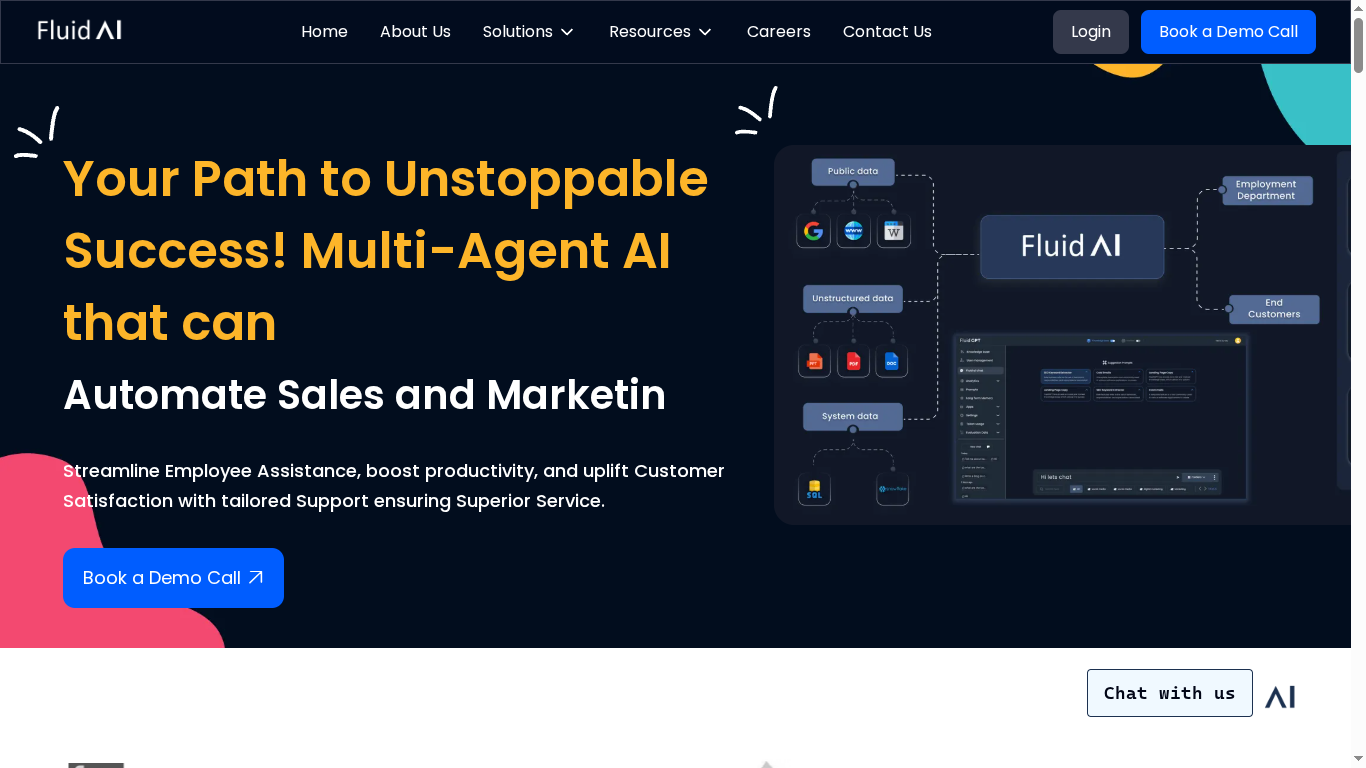
Fluid AI offers Agentic RAG (multi-agent AI): it thinks, acts and optimizes autonomously, automating secure, scalable workflows — rapid efficiency gains, deployment ≈60 days.
Company snapshot
- Headcount
- 41 (2026-01-01)
- Followers
- 12,075 (2026-06-19)
- HQ
- Mumbai, India
Headcount growth
Based on LinkedIn data.
Facts
- Industry
- IT Services and IT Consulting
- Competitors
- CognigyKore.aiGoogle Dialogflow
- Customers
- No customers found
- Employees
- 41
- Followers
- 12,075
- Review created
- Last reviewed
Fluid AI Review 2026: The Ultimate Multi-Agent Platform for Enterprises?
Key Feature Rating & Critique Ideal for Multi-Agent Orchestration & Private LLMs 4.5/5 - Strong in Security, but Opaque Pricing Regulated Industries (Banks, Insurance)
Introduction & Conclusion
Fluid AI is a leading enterprise AI platform specializing in moving generative AI from the research phase to production. By combining multi-agent systems, RAG technology, and flexible deployment options (on-premises/cloud), Fluid AI provides a secure solution for complex workflows in regulated industries. It is the ideal choice for companies that demand maximum data sovereignty and rapid implementation times of under 60 days.
The core problem: The hurdles of AI production
Many companies today fail not due to a lack of AI ideas, but due to the implementation in a secure production environment. The main problems are:
- Lack of data security and governance in public LLMs.
- Complexity in integrating with existing legacy systems.
- Difficulties in scaling AI agents for real-world business processes.
- Lack of transparency and control over data flows.
The solution: Fluid AI Multi-Agent Platform
Fluid AI addresses these problems through an architecture designed for security and orchestration.
Agentic AI & Orchestration
Unlike simple chatbots, Fluid AI uses a multi-agent structure. Various specialized AI agents work together to automate complex tasks in customer support, operations, and sales. This enables more precise processing of queries that go beyond simple text generation. Flexible Deployment Models: A unique selling point is its flexibility. Fluid AI can be operated in the cloud, in a hybrid environment, or completely on-premises (air-gapped). This is particularly crucial for banks and insurance companies, which are never permitted to release their data to a public cloud. RAG & Private LLMs: Through Retrieval Augmented Generation (RAG), the agents access internal company data without requiring the model to be retrained. Furthermore, private LLMs can be hosted in the customer's own infrastructure, guaranteeing maximum data sovereignty. Use Cases in 2026: The platform is currently used in a variety of scenarios: Banking: Automation of credit checks and KYC processes by specialized agents. Insurance: Fast claims processing through AI-supported analysis of documents and photos. Customer Service: Use of digital humans (AI avatars) that provide empathetic and precise assistance. Supply Chain: Predicting supply bottlenecks through AI analysis of large data sets. Security & Compliance: Fluid AI places great emphasis on certifications. The company states that it is ISO 27001 certified. Regarding SOC 2 Type II, there are conflicting statements (partially listed as existing, partially in process), which necessitates a careful review of current audit reports by potential customers. GDPR compliance is a core component of the architecture for the European market. Pricing & Market Analysis: Fluid AI follows a classic enterprise sales model. There are no publicly available price lists. Interested parties must book a demo to receive a customized offer based on usage volume and deployment type. Competitive Comparison: Compared to competitors such as Cognigy, Rasa, or Ada, Fluid AI positions itself more strongly in the area of deep integration and multi-agent orchestration for large enterprises. While tools like HubSpot or Intercom are more focused on SMEs and simple support, Fluid AI targets highly complex, regulated environments. Summary of Results: Companies using Fluid AI report a significant reduction in turnaround times and improved scalability of their AI initiatives. The promised implementation time of 60 days is an aggressive target that underscores the platform's efficiency. Despite its opaque pricing, Fluid AI offers one of the most robust solutions for enterprise use of generative AI in 2026.
Recent (last 90 days)
News & updates
FluidAI Medical's Origin device has been granted FDA 510(k) clearance, which allows for its use in the U.S. healthcare system. This milestone represents a major advancement in the company’s mission to improve postoperative care through technology. The device aims to provide timely data-driven insights that can prevent complications and enhance recovery for patients after surgery.
Company
Fluid AI offers Conversational AI solutions & AI Analytics for business decisioning. We have received 2 patents for our technology and innovations. Fluid AI has worked with over 60+ international clients and has a presence in 8 countries. We offer solutions to some of the biggest banks in the world - Bank of America, RBC, Barclays, Emirates NBD, ICICI, HDFC, Axis and MNCs like Deloitte, Capgemini, Accenture, Jio, etc. We have worked with Forbes USA for their 100th Anniversary issue featuring Warren Buffett to launch the world’s first interactive digital human. Check out our solution on: https://www.youtube.com/watch?v=No-aiHiuijY Fluid AI has been named “Top Deep Learning Vendor” by Forrester and “Cool Vendor for Artificial Intelligence” by Gartner. The company was founded by Raghav and Abhinav Aggarwal and is headquartered in Mumbai, India. Their passion for coding and innovation led them to build one of the most exciting startups in India. They were a part of the Forbes 30 under 30 Asia list for 2017 and Fortune 40 under 40 India list for 2018. They also won one of the world's biggest 24-hour coding competitions, the TechCrunch Disrupt Hackathon in New York.
LinkedIn ↗