

Seamless
Problem: Sales teams waste time with outdated contacts. Solution: Real-time AI search delivers verified B2B contacts. Result: Faster deals, increased revenue.
Company snapshot
- Headcount
- 390 (2026-01-01)
- Followers
- 69,076
- HQ
- Columbus, Ohio
Headcount growth
Based on LinkedIn data.
Facts
- Industry
- Software Development
- Competitors
- ZoomInfoApollo.ioClearbit
- Customers
- Unknown
- Employees
- 390
- Followers
- 69,076
- Review created
- Last reviewed
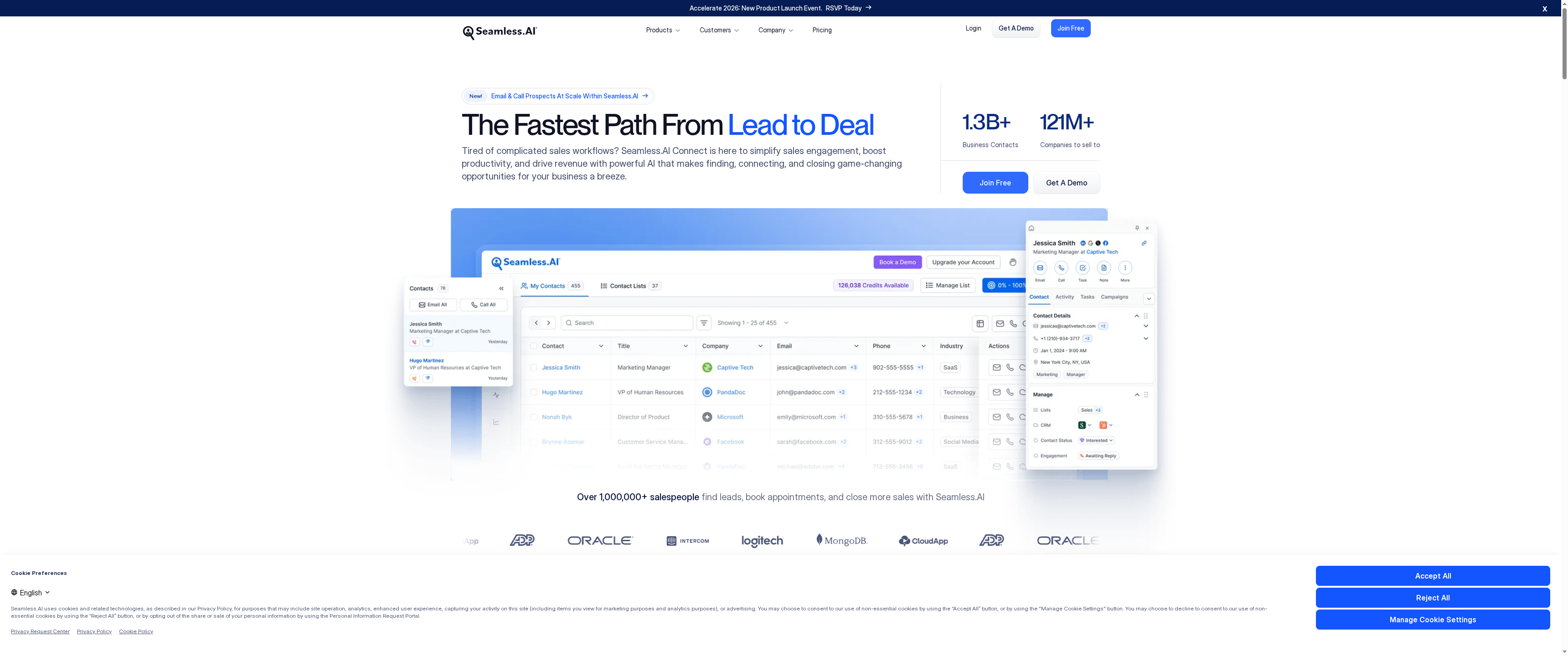
Seamless.ai Review 2026: The Ultimate B2B Sales Platform Put to the Test
Key Feature Rating & Critique Ideal for Real-Time AI Search 4.2/5 - Strong Usability, but Fluctuating Data Quality Sales Teams & Recruiters
Introduction & The Expert Verdict
Seamless.ai remains a powerful lead generation tool in 2026, distinguished primarily by its speed and deep CRM integration. While the software solves the problem of time-consuming manual lead generation, users often face challenges with data accuracy and a complex credit structure. For teams that prioritize volume and speed, it's a top choice, while compliance-focused companies should consider alternatives. The core problem: Why do we need Seamless? In modern sales, time is the most valuable resource. Salespeople often spend up to 60% of their time researching contact information instead of actually selling. Outdated databases and incomplete LinkedIn profiles lead to high bounce rates and frustrated sales teams. This is where Seamless comes in, promising to close the gap between identifying and contacting leads in real time. The solution: How Seamless is revolutionizing sales. Seamless.ai acts as an AI-powered search engine for B2B contacts. Instead of relying on static, often outdated databases, the AI scans the web and social networks in real time to verify emails and mobile phone numbers. AI-powered search engine: The platform allows users to filter specifically by job title, industry, and company size. The AI immediately validates the found data to minimize the error rate. Chrome browser extension: A key feature is the extension that integrates directly with LinkedIn and Sales Navigator. With one click, profiles can be extracted and transferred directly to your own CRM system. Seamless CRM integration: The software offers native interfaces to Salesforce, HubSpot, and Microsoft Dynamics. This eliminates manual data import and ensures a clean workflow. Results: What users can expect in 2026. Implementing Seamless typically leads to a significant increase in outreach frequency. Users report saving several hours per week. However, there are downsides: Data quality is not error-free. Especially with mobile numbers, the hit rate is often only 60-70%, which can lead to frustration with credit-based billing. Practical Use Cases for 2026: Hyper-Personalization: Using the Insights feature to incorporate current company news into initial contact. Automated Pipeline Filling: Exporting target audience lists daily directly into automated email sequences. Recruiting: Quickly finding passive candidates outside of mainstream job boards. Pricing & Value Analysis Comparison: Seamless's pricing model is credit-based. There is a free version with approximately 50 credits. Paid packages start at around $147 per month (billed annually). Compared to competitors like ZoomInfo, Seamless is cheaper and more accessible for SMEs, but offers less in-depth business data than the market leader. Seamless vs. Apollo.io: Apollo offers stronger automation tools within the platform, while Seamless focuses more on pure data extraction via a Chrome extension. Seamless vs. Cognism: For European businesses, Cognism is often the better choice, as they place a stronger emphasis on GDPR compliance and verified European mobile numbers. Advantages and disadvantages at a glance: Advantages: Intuitive operation, fast lead extraction, good integrations. Disadvantages: Credit consumption even with inaccurate data. LinkedIn policy risks, support response times.
Conclusion: Is Seamless.ai worth it?
Seamless.ai is an excellent tool for agile sales teams that want to grow quickly. Those willing to trade a certain degree of data inaccuracy for massive time savings will find one of the best solutions on the market. However, companies with strict compliance requirements should closely monitor developments regarding LinkedIn scraping.
Recent (last 90 days)
News & updates
Seamless.AI was recognized for its commitment to exceptional company culture, which includes prioritizing employee well-being, fostering respect and support, encouraging innovation, and promoting work-life integration, attracting top talent.
Company
Seamless.ai delivers the world's best sales leads. Maximize revenue, increase sales and acquire your total addressable market instantly using artificial intelligence. Join thousands who are generating millions today at www.seamless.ai.
LinkedIn ↗